The Silk Roads: A New World History
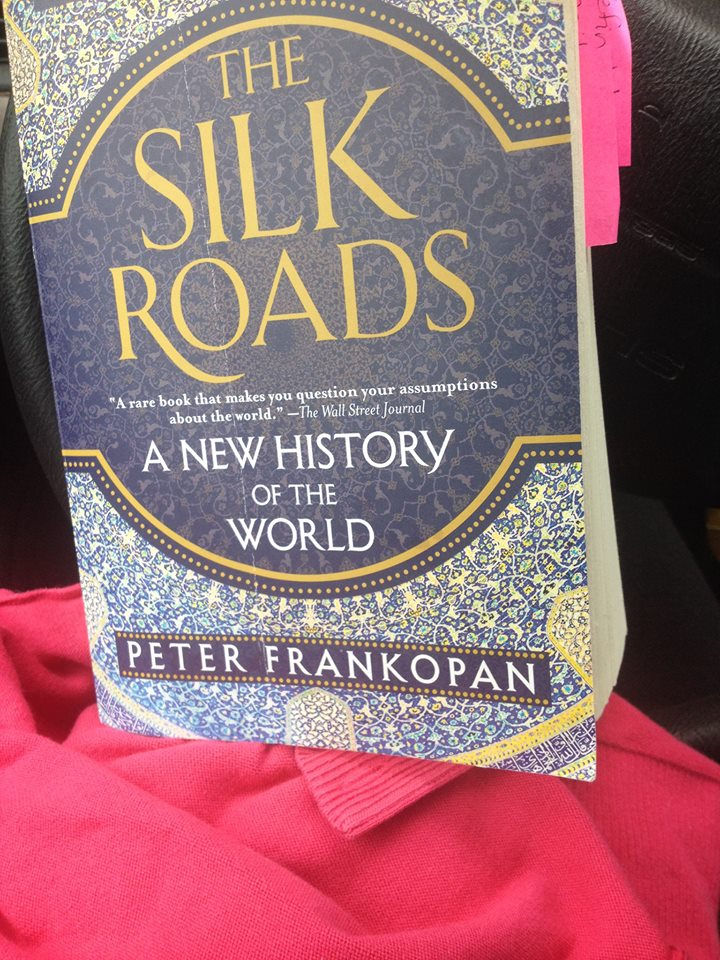
I've been talking about this books for weeks on Facebook; it's about time I wrote a review. Usually I read three to five non-fiction books during my one month Fiction Fast. This book, by Peter Frankopan, took over my Fast. Although over 500 pages long, I never lost interest, but it did take me more than a month to get through it. Be forewarned if you decide to tackle all of world history.
And I do mean all. The very first sentence: "From the beginning of time, the centre [British spelling] of Asia was where empires were made." The last chapter discusses the Middle East in 2015. Literally, the book encompasses all of history.
The premise of Frankopan's analysis of history is that the Middle East has always been the center of economics, culture, education, and beauty, even if Western Civilization has not acknowledged it. Power has always rested in the east.
Alexander the Great lived in eastern Europe. When he conquered the known world, he didn't look to the west. He conquered the east, making his way rather quickly toward India. In the years following, there was a cultural exchange between the Greeks and the eastern cultures. This was the first time people living in the west came into contact with the luxuries of the east, specifically the silk of China, and so the Silk Road was created.
Over the next centuries, luxury items were traded; different peoples were conquered, and then their conquerors were conquered nomads gained power and wealth through trade; and slaves were traded so that DNA as well as cultures were mixed. It explains the mixed results of modern DNA test kits, which have gained popularity in the past few years. "I thought I was Italian. How did I end up with Norwegian blood?" Slaves. "I thought I was German. How did I end up with Arab blood?" The migration of peoples as they followed trade.
Frankopan doesn't gloss over the horrors perpetrated by both sides during the Crusades. He doesn't elevate one culture over another to force an agenda. For the most part, he sticks to the facts. I came away with a deeper understanding, and it also underscored my own belief that all of history is a line, not a circle, and everything affects and is an effect of everything else. No man is an island, and no country's history is untouched by every other.
If you decide to read The Silk Roads by Peter Frankopan, keep in mind it will take you a long time to finish, but it's well worth the time.


Comments